Your Cart
Loading

Practical resources for behavioural futures

The Institute of Behavioural Futures creates publications, tools, and learning resources that help individuals and organisations connect futures thinking with behavioural insight.

These resources are designed to support reflection, decision-making, strategy, learning and action. Some are free public outputs, while others are paid digital products or tools available through external checkout.

Featured publication: Quiet Future Report 2025

The Quiet Futures Report 2025 is the flagship publication of the Institute of Behavioural Futures.

It explores slow, cumulative and often unnoticed shifts shaping everyday life and future societies through a Nordic-Baltic lens. The report connects futures thinking with behavioural mechanisms and asks how quiet changes in behaviour, infrastructure, expectations and culture may shape the world towards 2040.


Best for:

decision-makers, foresight professionals, educators, strategists, public sector actors and reflective practitioners.

Format:

Digital report

Reflection and learning resources

Futures Literacy Journal

The Futures Literacy Journal is a guided reflection tool for people who want to strengthen their ability to use futures in everyday thinking and decision-making.

It combines futures literacy, mindfulness, and practical foresight methods, including reflection prompts, trendspotting, futures wheels, scenarios, and backcasting.

The journal helps users explore future assumptions, emerging signals, alternative futures, personal agency, and action in the present.

Best for:

individuals, students, educators, coaches, reflective practitioners, and teams, beginning with futures thinking.

Format:

PDF

Languages:

English, Finnish, and Estonian

Self-paced online learning

Introduction to Behavioural Futures

A self-paced course for connecting futures thinking with everyday behaviour and decisions. Explore six modules and twelve lessons, with quizzes and a downloadable workbook featuring the Behavioural Futures Action Map.


Pre-order for €79 total, including applicable VAT. Course access opens 27.10.2026. Includes a 14-day satisfaction guarantee from launch.

Best for:

strategists, foresight and behavioural-insights practitioners, facilitators and change professionals who want to connect futures thinking with everyday behaviour. No prior futures or behavioural science experience needed.

Format:

self-paced online course · 6 modules · 12 lessons · quizzes · downloadable workbook (PDF)

Diagnostics and workbooks

Strategy–Behaviour Alignment Diagnostic

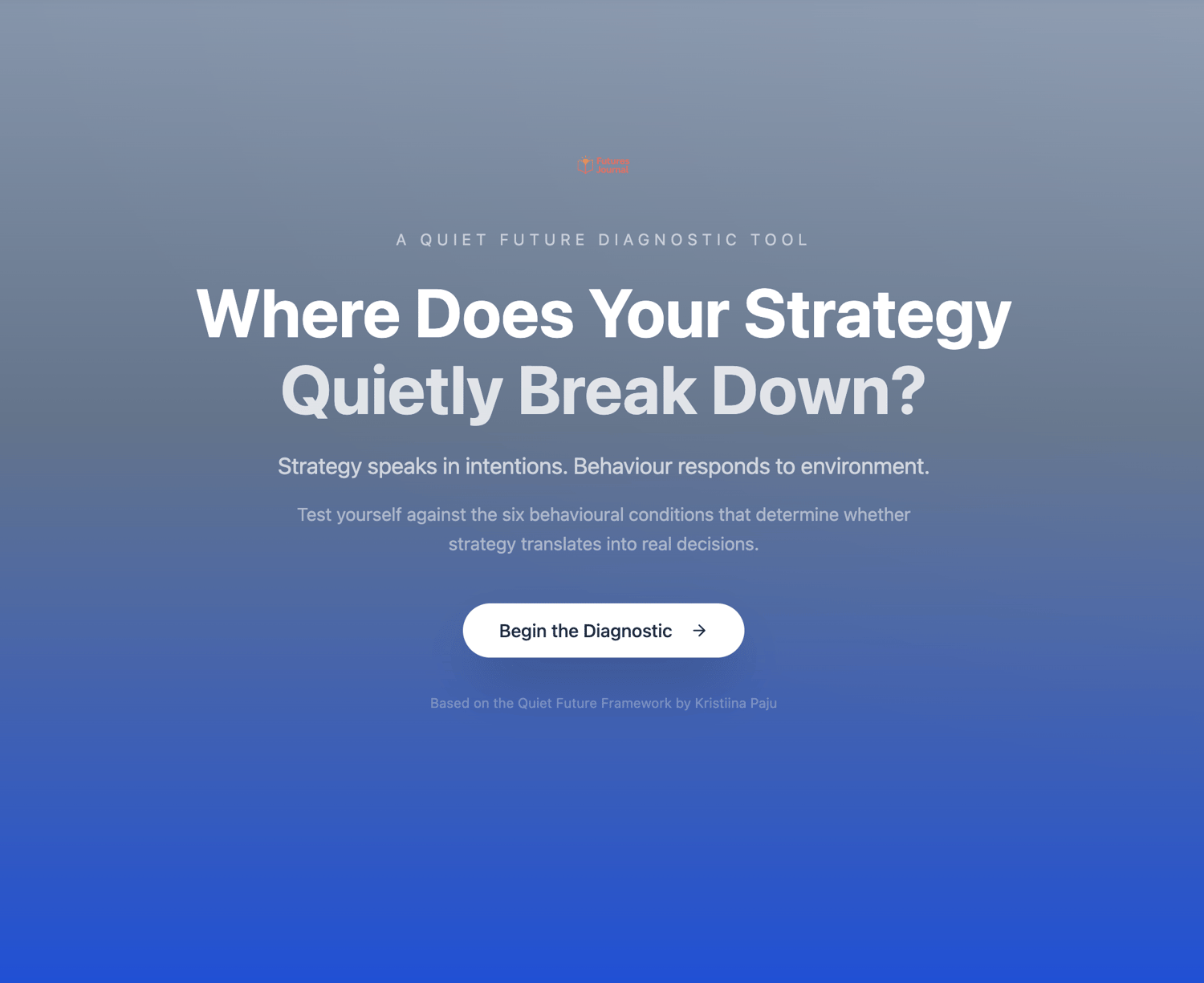
The Strategy–Behaviour Alignment Diagnostic helps organisations identify where strategy may erode because the behavioural conditions around it do not support action.

It is built around six conditions:

Agency. Defaults. Friction. Capacity. Attention. Meaning.

The diagnostic supports structured reflection on whether people have the room, resources, attention and motivation needed to act on strategic goals.

Best for:

leadership teams, strategy teams, public sector organisations, associations, NGOs, and organisational development work.

Format:

Workbook / digital diagnostic

Digital tools and labs

Quiet Future Lab

The Quiet Future Lab is the practical experimentation space connected to the Institute of Behavioural Futures.

It brings together diagnostics, reflection tools, and behavioural futures methods that help translate insight into action. The Lab is designed for exploring strategy-behaviour alignment, decision-making, agency, defaults, and future-oriented choices more interactively.

Best for:

teams, facilitators, educators, consultants, and organisations that want to test behavioural futures tools in practice.

Format:

Digital tool/app access

Decision-making tools

The Ripple

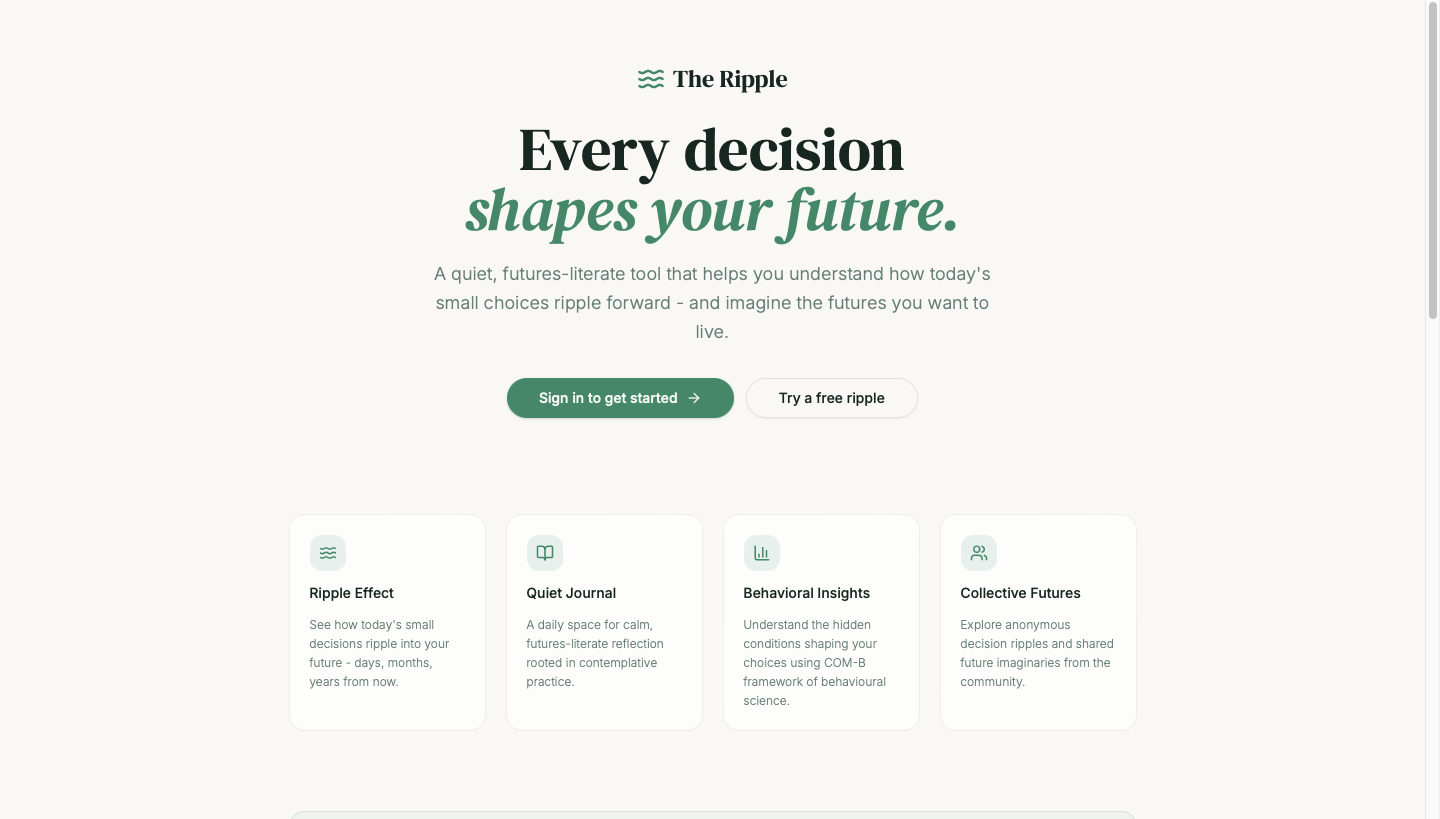
The Ripple is a future-oriented decision journaling app that helps users explore how today’s choices may create short-, medium-, and long-term consequences.

It combines reflective decision journaling with behavioural insight and futures thinking. Users can record decisions, alternatives, and context, then explore possible ripple effects through different future lenses.

The app is designed to support slower, clearer, and more future-aware decision-making — especially when choices feel complex, uncertain, or emotionally loaded.

Best for:

individuals, professionals, students, leaders, and reflective practitioners who want to understand their decision patterns and think more carefully about future consequences.

Format:

Digital app/decision journal

Quiet Future Portfolio

Behavioural Futures in Practice

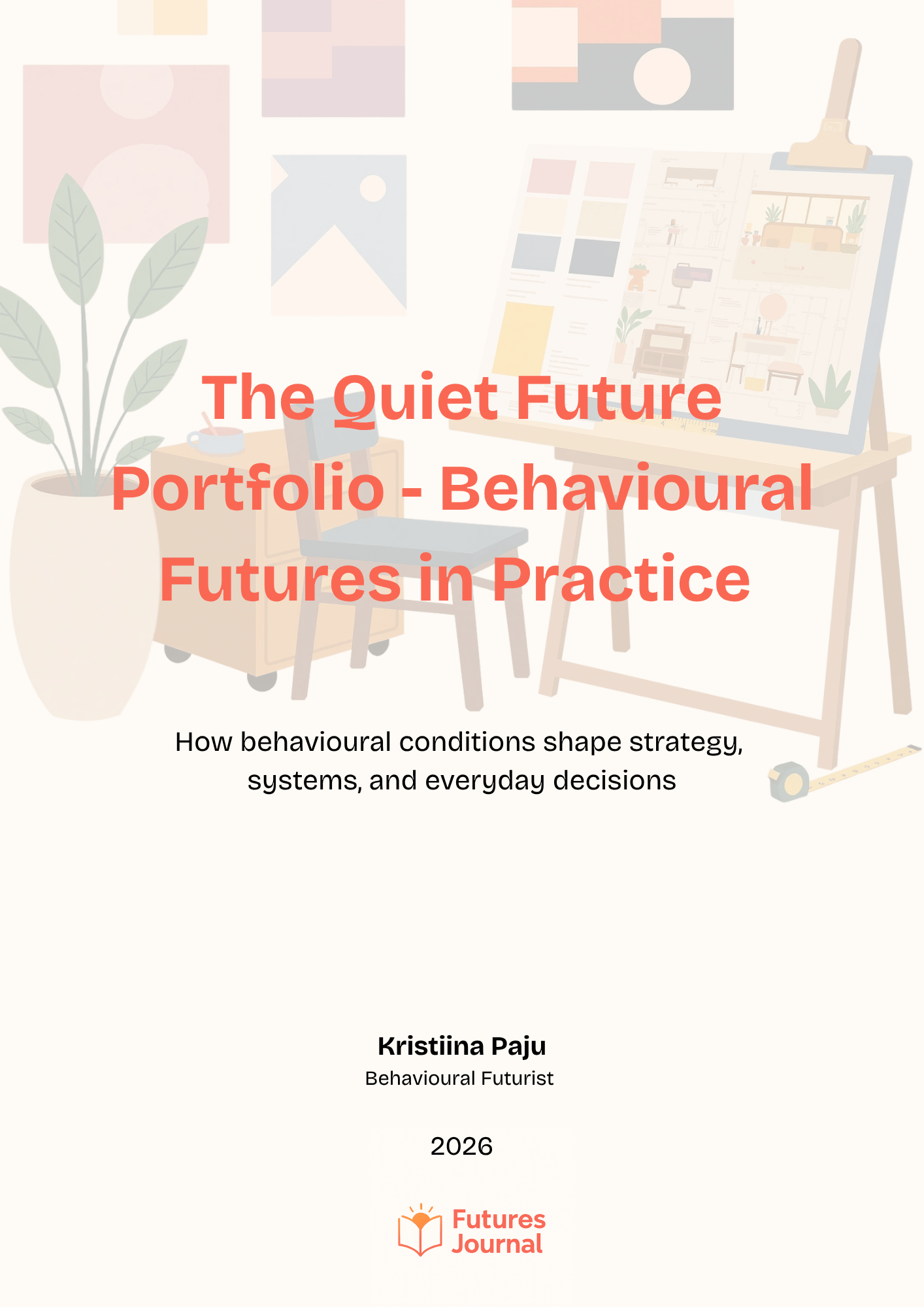
The Quiet Future Portfolio – Behavioural Futures in Practice 2026 presents selected examples of how behavioural conditions shape strategy, systems, and everyday decisions.

The publication demonstrates how behavioural futures work can be applied in practice: not only by imagining preferred futures, but by examining the everyday conditions that determine whether those futures can actually take shape. It introduces the Quiet Future Framework and its six behavioural conditions — agency, defaults, friction, capacity, attention, and meaning — as a way to understand where strategy and behaviour align, and where they quietly drift apart.

The portfolio includes applied cases from urban mobility, a small food industry business in Finland, and wind energy in the Baltic Sea Region. Across these cases, the publication shows how strategic intent can be clear while behaviour remains stable because existing systems make old patterns easier, safer, or more familiar than new ones.

This publication is especially useful for organisations, partners, and collaborators who want to understand how behavioural futures thinking works in real contexts — and how it can support strategy, policy, innovation, organisational change, and future-oriented decision-making.

Best for:

strategy teams, public sector organisations, innovation actors, foresight professionals, organisational development practitioners, and potential advisory partners.

Format:

Digital portfolio / applied publication
For organisations

Some tools are currently available for individual use, while organisational versions, workshops, and facilitated applications can be arranged separately.


For teams and organisations, these resources can be combined with:


  • briefings
  • workshops
  • diagnostics
  • facilitated reflection
  • strategy sessions
  • custom research and advisory work

Access and checkout

Digital products and paid tools are delivered through external checkout pages. Product pages include details on format, language availability, licensing, and access.


View available publications and tools


Need help choosing?

Future-oriented work can begin from many places: a report, a journal, a diagnostic, a workshop, or a conversation.

The best starting point depends on whether you want to understand change, reflect on your assumptions, strengthen strategy, redesign a decision environment, or build futures literacy in a team.

Blog Posts

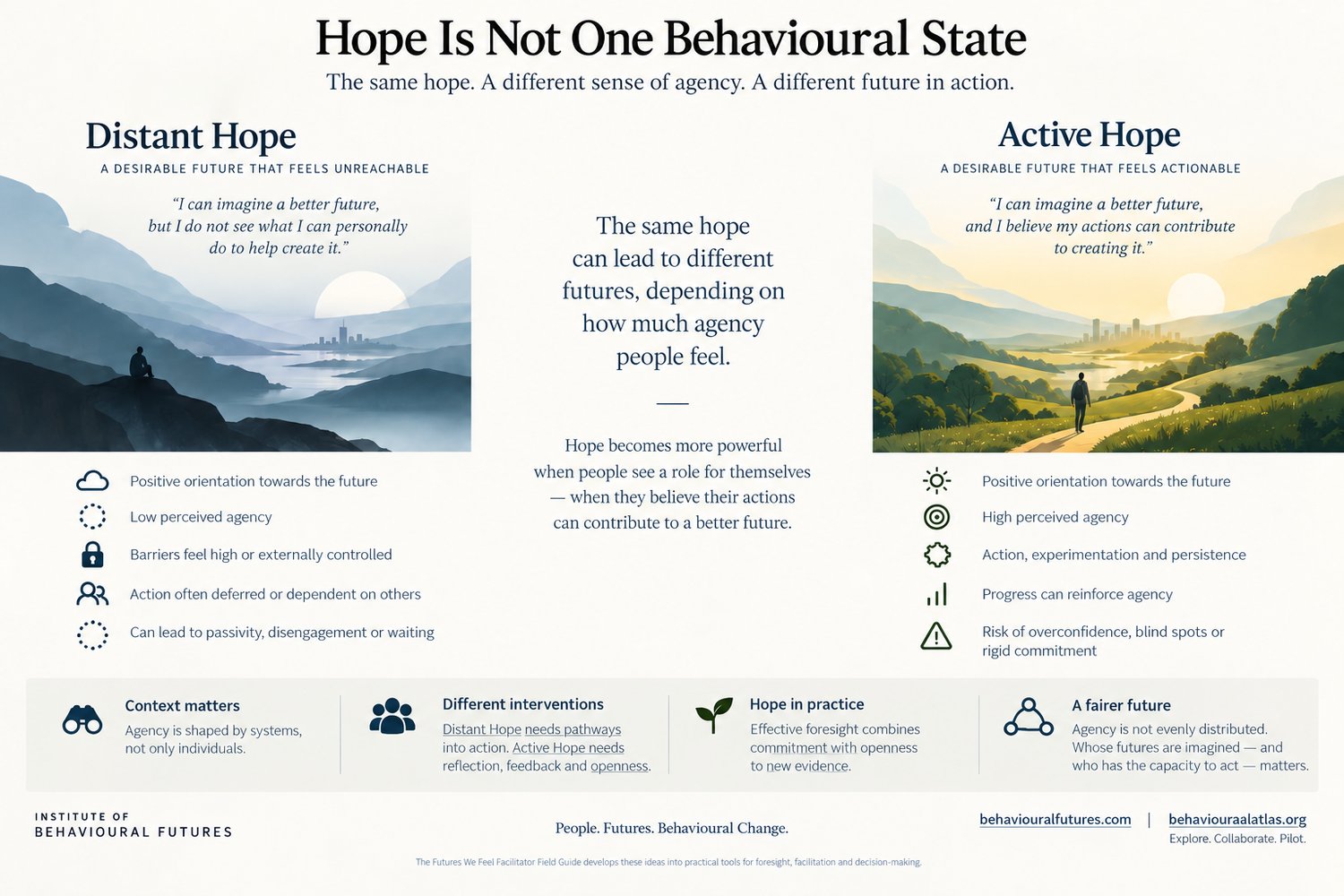
Hope Does Not Translate Into One Behavioural State: Distant Hope, Active Hope and the Role of Agency
Hope is often treated as a uniformly positive orientation towards the future. In strategy, foresight, organisational change, and public engagement, hopeful attitudes are frequently interpreted as signs of readiness, motivation, or openness to action...
Read More
A practical companion to the Futures We Feel Facilitation Cards is taking shape
JOIN THE WAITING LIST! Alongside the Futures We Feel facilitation cards, I am currently preparing something a little more substantial: the Futures We Feel Facilitator Field Guide. I am 100% not sure yet whether the name will reflect Futures We Feel ...
Read More
Futures We Feel: July 2026 Progress Update
July marked the second full month of coordinated data collection for the Behavioural Atlas. While the number of responses remains small, the early signals are already showing why it matters to examine feelings about the future together with people’s...
Read More