What happens during the mapping?
1. Understand the current situation
Pre-assessment questionnaire and separate interviews with the current owner and successor.
2. Map the dependencies
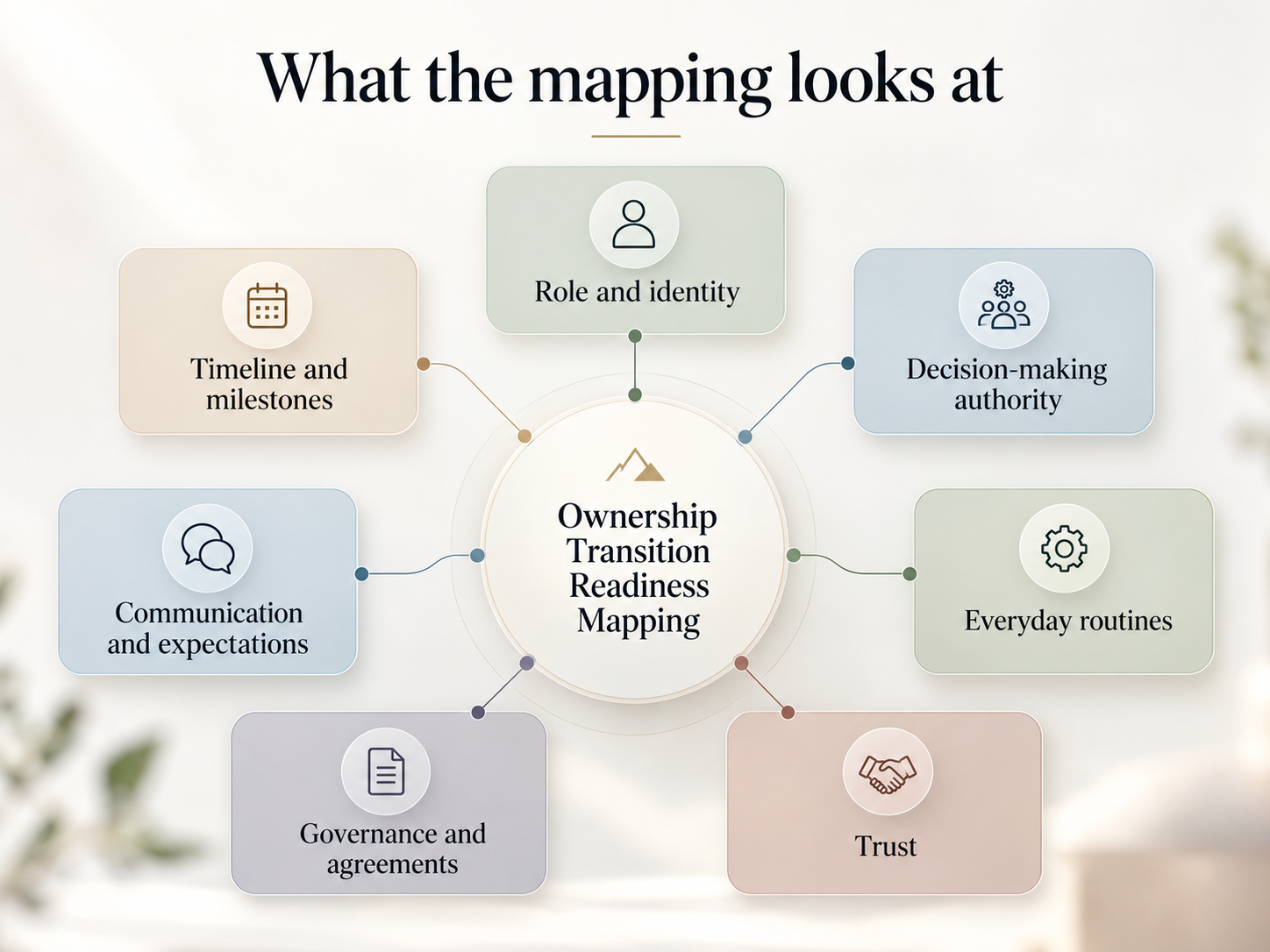
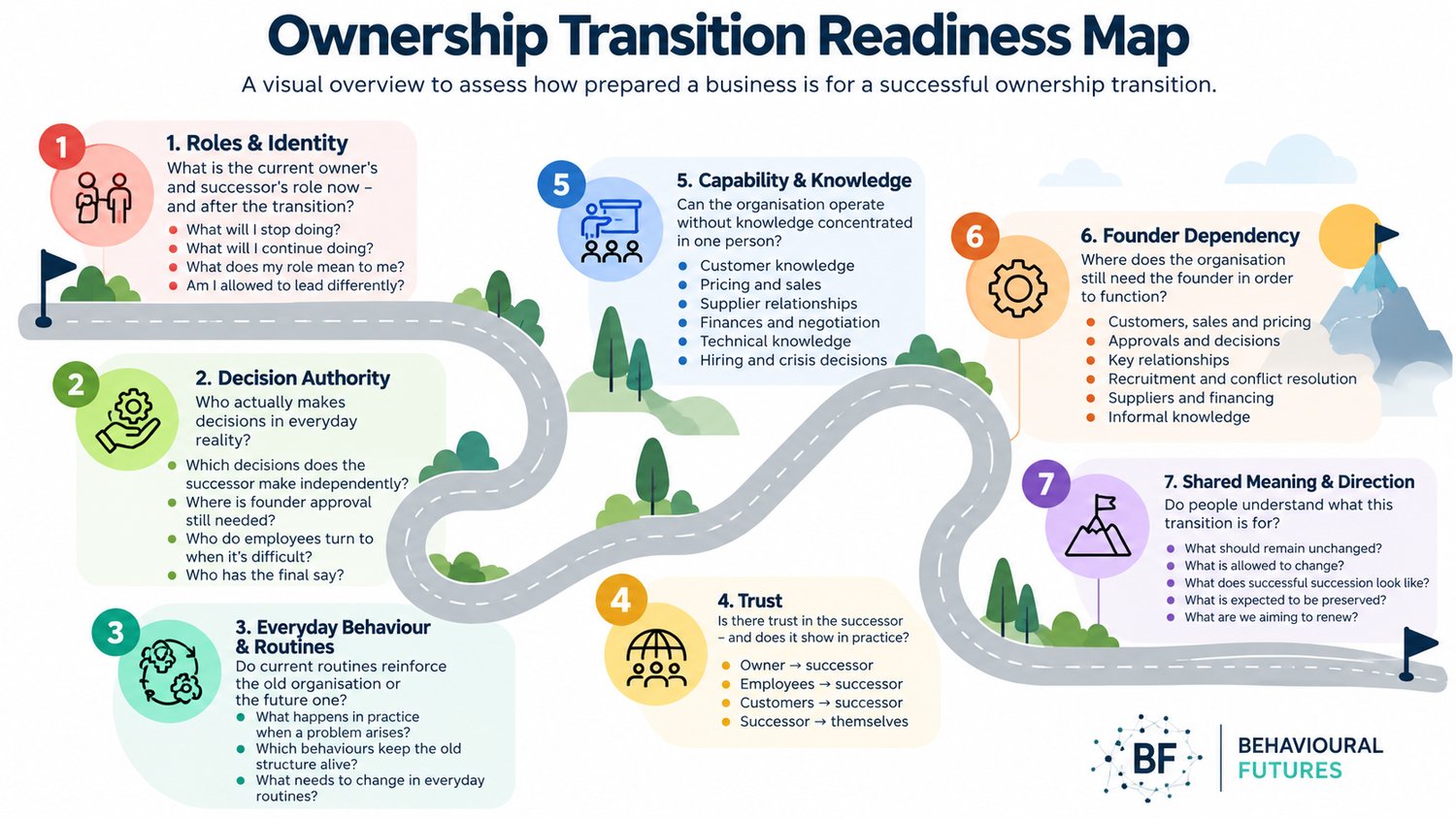
We identify founder dependency, decision-making authority, responsibilities, trust, routines, and key transition risks.
3. Work through the findings together
A joint working session helps clarify where expectations, responsibilities, or perceptions differ.
4. Turn the findings into action
You receive the readiness maps, priority risks, and a concrete 90-day transition plan, followed by a joint review.
What do you receive?
At the end of the process, you receive:
- Ownership Transition Readiness Map
- Founder Dependency Map
- 3–5 priority transition risks
- clear recommendations
- 90-day transition roadmap
You will know what is already working, where the transition is still incomplete, and which actions matter most next.
This mapping is especially useful when...
- the owner plans to reduce their operational role
- responsibility is moving to the next generation
- a successor is already working in the business, but authority is still shifting
- leadership and ownership are changing at different speeds
- the board wants to reduce dependency on one individual
The mapping works best when the transition is already being planned or is currently underway.
Why Behavioural Futures?
Ownership transitions are usually supported through legal, financial and tax expertise. Those are essential.
But the organisation must also learn to operate differently.
Authority needs to move.
Routines need to change.
Trust needs to develop.
Knowledge needs to transfer.
Behavioural Futures examines the gap between an intended future and what people actually do in practice.
The Ownership Transition Readiness Mapping applies that perspective to ownership, leadership and generational transitions.
Investment
Ownership Transition Readiness Mapping
€1,900 + VAT
Includes the full assessment, two individual interviews, joint working session, readiness maps, risk assessment and 90-day action roadmap.
This is designed as a focused intervention rather than a long consulting project. The purpose is to identify the dependencies most likely to complicate the transition and turn them into practical next steps.