
Most organisations say they want to think long-term. Many invest in foresight, strategy processes, trend reports, scenarios, workshops, and transformation programmes. Yet even when future risks and opportunities are visible, decision-making often remains surprisingly reactive, short-term, and constrained by familiar assumptions.
Why?
One answer may lie in a question that strategic foresight has not always explored deeply enough:
How do cognitive biases shape the way we imagine, interpret, and act toward the future?
This question sits at the centre of my current master’s thesis and research pilot at the Institute of Behavioural Futures.
The gap between foresight and behaviour
Strategic foresight is often described as a way to explore alternative futures, challenge assumptions, and strengthen preparedness under uncertainty. But foresight processes are still carried out by human beings — and human decision-making is not fully rational.
Research in behavioural science and psychology has repeatedly shown that people rely on heuristics, mental shortcuts, emotional interpretations, and past experiences when making decisions. These tendencies help us function efficiently in everyday life, but they can also narrow our thinking in situations that require openness, adaptability, and long-term reflection.
In foresight work, this may appear as:
- overreliance on past trends
- confirmation bias in interpreting signals
- preference for familiar futures
- status quo thinking
- resistance to uncertainty
- overconfidence in existing assumptions.
In other words, even when we attempt to think about the future, we may remain cognitively anchored in the present.
From awareness to intervention
My thesis explores whether game-based interventions can help make these hidden patterns more visible.
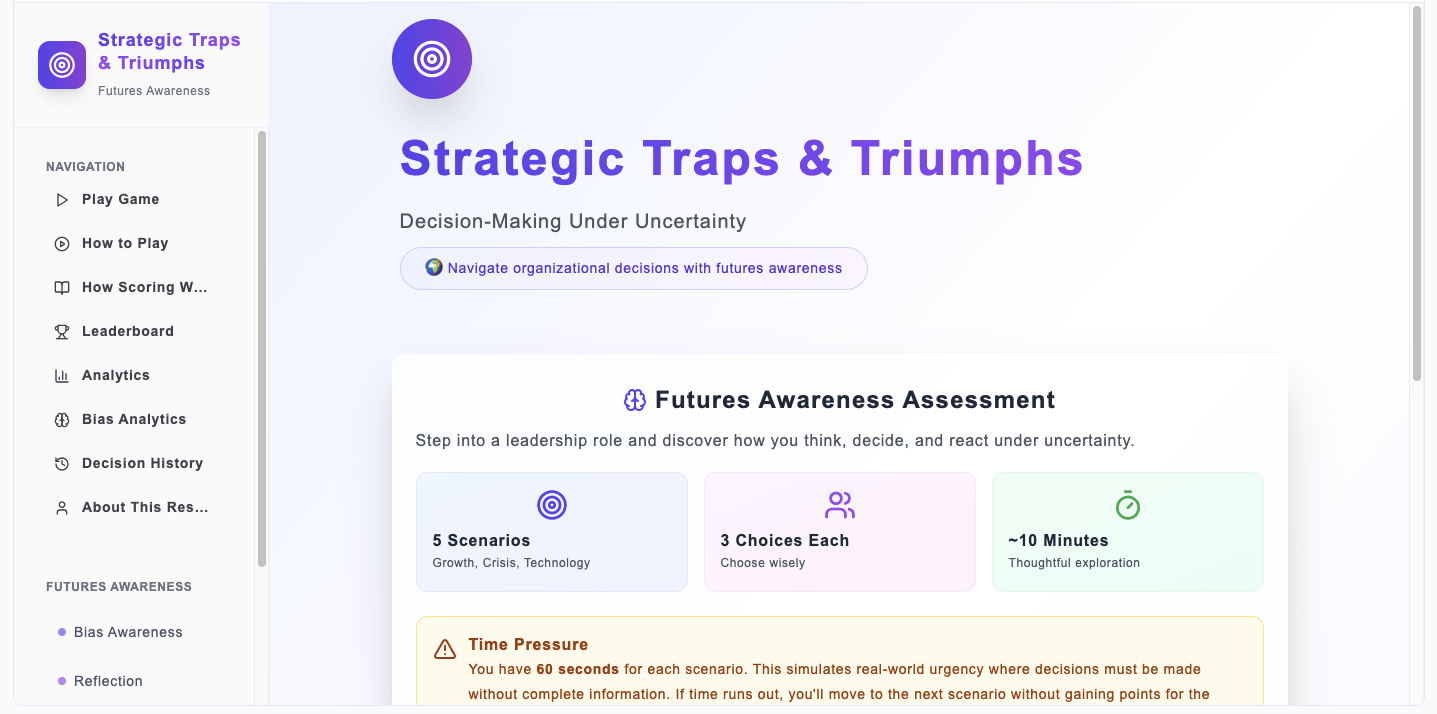
As part of the research, I developed Strategic Traps & Triumphs, an experimental decision-making game that places participants into uncertain strategic situations under time pressure. The purpose is not to “win” the game, but to reflect on:
- how decisions are made under uncertainty,
- how cognitive biases emerge in practice,
- how assumptions shape strategic thinking,
- and how futures awareness might be strengthened through reflection.
The intervention combines:
- behavioural science,
- cognitive bias research,
- strategic foresight,
- futures literacy and futures consciousness,
- game-based learning,
- reflective decision-making.
Participants move through a three-stage intervention:
- pre-survey
- game-based intervention
- post-survey reflection
The goal of the first pilot phase is not statistical generalisation, but to evaluate the intervention’s ability to provoke reflection, surface thinking patterns, and support futures-oriented awareness.
Futures awareness as a practical capability
One of the most interesting discoveries during the development process has been the importance of what I currently describe as futures awareness.
Not merely “thinking about the future”, but recognizing:
- how biases shape anticipation
- how assumptions influence strategy
- how uncertainty affects choices
- and how people position themselves as agents within possible futures.
The game, therefore, includes reflective feedback and a “Bias Analytics” section, where participants can review cognitive patterns connected to strategic foresight and export a summary PDF for further reflection.
The intention is not to judge decision-making, but to make it more visible. And to allow participants to become more aware about what biases are and what they mean for foresight work.
Why this matters
Many organisations are currently operating in environments defined by uncertainty, rapid technological shifts, geopolitical instability, ecological transition, and increasing complexity.
In such environments, strategic foresight cannot remain only a forecasting exercise or trend discussion.
It also requires behavioural understanding:
- How do people interpret uncertainty?
- Which futures feel psychologically acceptable?
- Which assumptions remain invisible?
- When do organisations become “future blind”?
- How do power, confidence, time pressure, and cognitive shortcuts influence strategic choices?
These questions are becoming increasingly important for leadership, governance, foresight practice, and organisational resilience.
A first pilot — and an evolving field
This research is still in its early pilot stage (I opened the data collection phase yesterday), but it reflects a broader direction I believe the field is moving toward: the integration of behavioural science and futures thinking.
Not only asking:
“What futures are possible?” But also: “How do human cognition, perception, and behaviour shape which futures we are capable of imagining and acting toward?”
That may ultimately be one of the most important foresight questions of all.
If you would like to take part in the study during the first pilot phase 5.5.2026-12.5.2026:
1) Fill in the pre-study survey here (English or Finnish)
2) Play the game itself (link will be at the end of the pre-study survey)
3) Fill in the post-game survey (English or Finnish) (very important for research, so please, do fill it in. The link can be found at the end of the game on the Decision Profile page)
Thank you in advance, Kristiina
Comments ()