

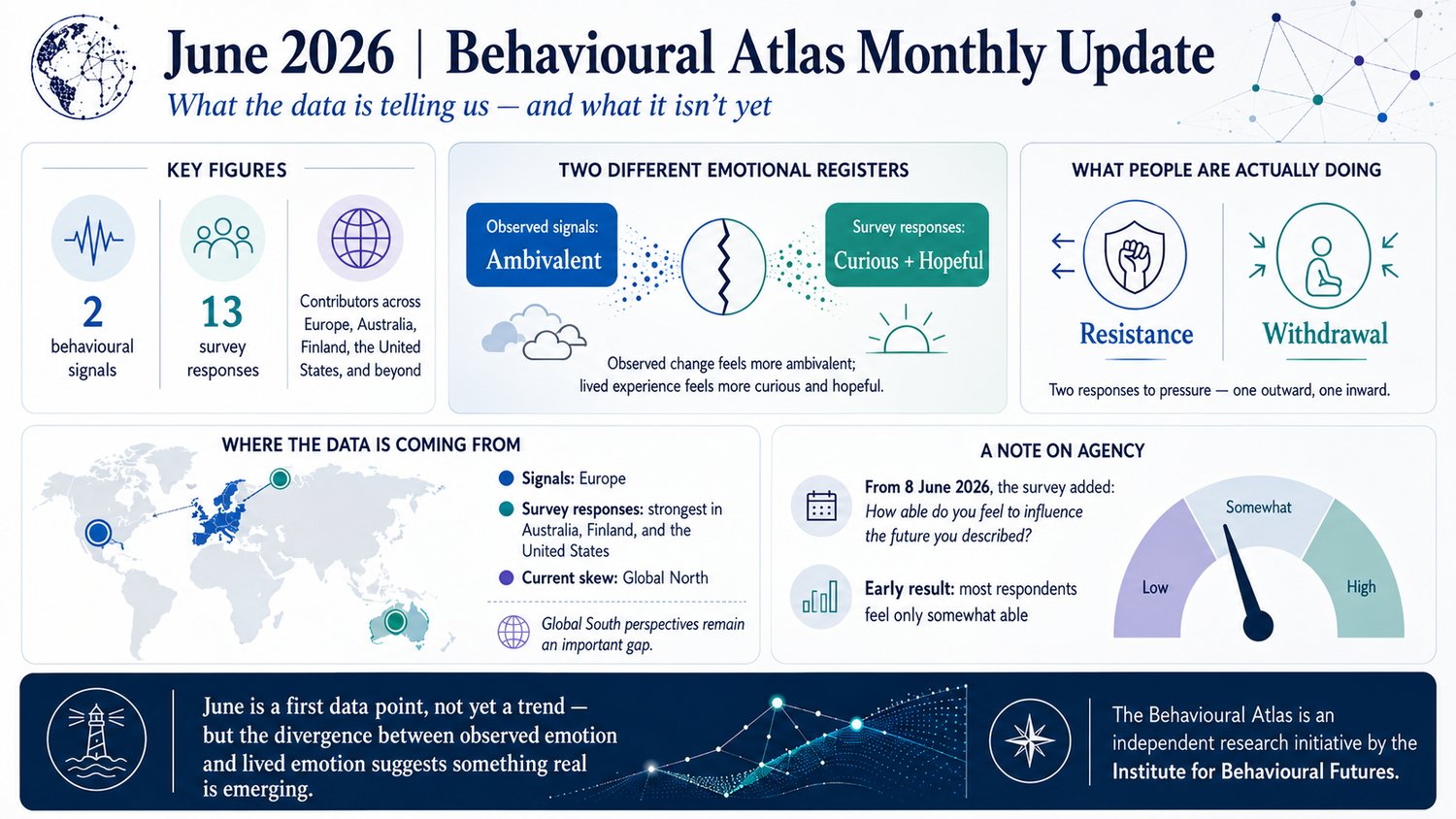
The Behavioural Atlas has now completed its first full month of live data collection. June 2026 brought in 2 behavioural signals and 13 survey responses from contributors across Europe, Australia, Finland, the United States, and beyond. This is the first monthly overview — and already, the data is doing something interesting: it's splitting.
Two different emotional registers
The most striking pattern in June's data isn't a single dominant feeling. It's a divergence.
Contributors who tagged behavioural signals — observing what's happening around them in the world — described those signals as Ambivalent. These are the words of people watching change unfold: not quite energised, not quite resigned. Watchful.
Survey respondents, by contrast — people reflecting on their own felt sense of the future — landed primarily on Curious and Hopeful. Exploratory. Open-ended. The language of someone still finding their feet in an uncertain landscape.
This gap matters. When the emotional register of observation differs from the emotional register of lived experience, it suggests we may be in a moment where collective behaviour is outpacing individual sense-making. People are doing things — responding, adapting, resisting — before they've fully processed how they feel about what's happening.
That's worth sitting with.
What people are actually doing: the mechanics
Every signal on the Atlas is tagged with a behavioural mechanic — the type of response being observed. June's two signals split between Resistance and Withdrawal.
That pairing is quietly revealing. Resistance says no, not like this. Withdrawal says I'm stepping back until I can figure this out. Both are responses to pressure — but they move in opposite directions. One leans outward, one leans inward. Together they reflect the range of ways people are coping with a future that feels both urgent and unresolved.
Where the data is coming from
Europe accounts for the signal contributions this month. Survey respondents are more geographically spread, with the strongest representation from Australia, Finland, and the United States.
This is worth naming clearly: the Behavioural Atlas currently skews Global North. The emotional and behavioural landscape it's mapping is real — but it's partial. Signal from the Global South, from communities in climate-vulnerable regions, from contexts where the relationship to uncertainty looks very different, remains a significant and important gap. Closing it is one of the Atlas's ongoing priorities.
A note on the agency data
From 8 June 2026, the survey included a new question: How able do you feel to influence the future you described?
Because this question was only introduced mid-month, the data is early and the sample is small. But of those who have answered so far, the majority say they feel only somewhat able to shape the future they described — not confident, but not entirely without agency either. A provisional, hedged sense of possibility.
We'll be watching how this develops across July and beyond, as the dataset grows and more respondents encounter the question. Agency is one of the most analytically important variables in the Atlas — the intersection of feeling and agency is where the most interesting behavioural patterns tend to emerge.
What comes next
The Atlas is still early. June represents a first data point, not a trend. But even now, the structure of what's emerging — the divergence between observed emotion and lived emotion, the pairing of Resistance and Withdrawal, the quietly exploratory tone in the survey responses — suggests that we're mapping something real.
If you haven't yet contributed a signal or taken the survey, both are open and anonymous. Every data point shifts the picture.
→ Explore the June data on the Behavioural Atlas
The Behavioural Atlas is an independent research initiative by the Institute for Behavioural Futures. All contributions are reviewed before publication. Survey responses are fully anonymous.
Comments ()