

Laura is ready to take over the family business. She knows the customers, understands the company, and wants to shape its next chapter. Her father, Matti, is also ready to step back.
At least, that is the plan. Then the phone rings. “Hi Matti, could you still take a look at this?”
Customers continue calling him. Employees still turn to him when something difficult happens. Matti answers because he wants to help. Laura waits because she does not want to push him aside.
The ownership transition may be progressing formally, while everyday behaviour keeps the old organisation alive.
This is why I approach succession as more than a transfer of ownership. It is a transition of roles, authority, trust, knowledge, routines and future direction.
Mapping what is really happening
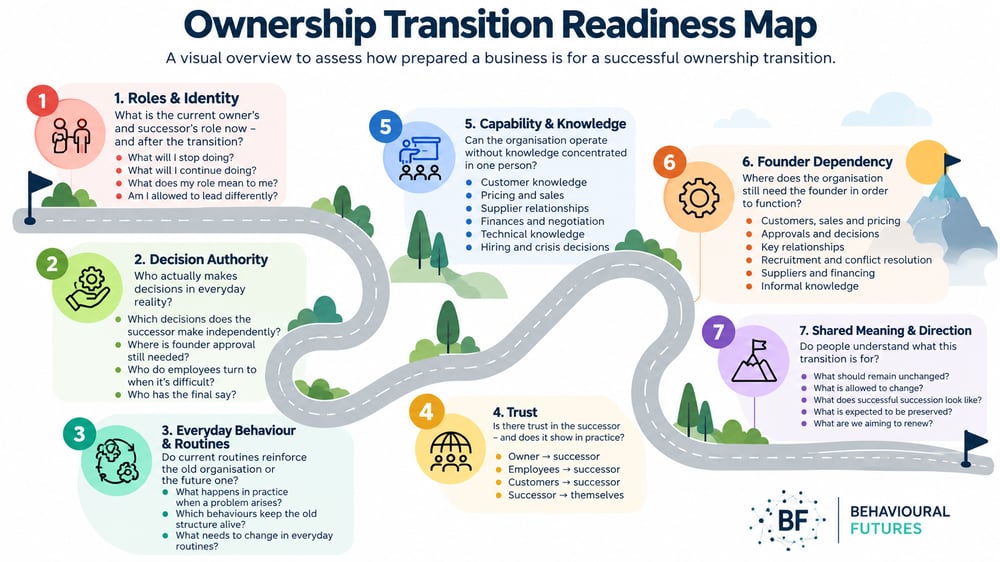
My ownership transition mapping process looks at seven dimensions that reveal where a succession is genuinely progressing—and where the business still depends on the old structure.
1. Role & Identity
What does stepping back actually mean for Matti? What will he stop doing, and what will remain part of his role? At the same time, is Laura genuinely allowed to become her own kind of leader, or is she expected to reproduce the way her father led the company?
2. Decision Authority
An organisation chart may say Laura is responsible, but everyday reality can tell a different story. We map which decisions she already makes independently, where Matti is still expected to approve, and who employees approach when something difficult happens.
3. Everyday Behaviour & Routines
Small routines can keep an old power structure in place. If an employee encounters a problem, calls Matti, and Matti solves it, everyone learns again that Matti remains the real decision-maker. We identify the behaviours that reinforce the past instead of the future.
4. Trust
Succession depends on more than competence. We examine trust from several directions: Matti’s trust in Laura, employees’ trust in Laura, customers’ trust in Laura, and Laura’s confidence in her own authority. We also look at how that trust becomes visible in practice.
5. Capability & Knowledge
Can the company function without critical knowledge being concentrated in one person? We map areas such as customer knowledge, pricing, supplier relationships, finances, negotiation, technical expertise, hiring, and crisis decisions.
6. Founder Dependency
One of the most important questions is simple:
Where does the organisation still need the founder to function?
That dependency may sit in customer relationships, pricing, sales, approvals, conflict resolution, recruitment, financing, or informal knowledge. Making these dependencies visible makes them easier to transfer deliberately.
7. Shared Meaning & Direction
Finally, we look forward. What should remain unchanged? What is allowed to change? What does continuity really mean? What is Laura expected to preserve — and what is she allowed to renew?
This is where strategic foresight becomes especially useful. Succession is not only about preserving what exists. It is also about preparing the business for what comes next.
From ownership transfer to a real transition
The purpose of the mapping is not to remove Matti from the business overnight. It is to understand where his continued involvement still creates value, where it creates dependency, and what needs to change so that Laura can genuinely lead.
A customer learning to call Laura instead of Matti may seem like a small behavioural shift. But multiplied across decisions, relationships, routines and responsibilities, those small shifts determine whether succession actually happens.
Ownership transfer changes who owns the business.
A successful transition changes how the business works — without losing what makes it valuable.
That is the transition I help organisations map and design through Behavioural Futures.
Learn more:
Comments ()